Visualizzazione post con etichetta V REGISTI INTERNAZIONALI. Mostra tutti i post

16 giugno 2020

Anurag Kashyap talks about his fight with KJo, meeting with SRK

Vi segnalo l'intervista concessa da Anurag Kashyap a Mayank Shekhar, pubblicata lo scorso 12 giugno da Mid-Day. Il testo include il video dell'intervista integrale. Anurag Kashyap talks about his fight with KJo, meeting with SRK:

'The first time ever that filmmaker Imtiaz Ali saw what a portfolio looked like (...) was that of an actor called Anurag Kashyap. Back then, Ali was in college in Delhi, helping out a local TV serial crew, when Kashyap approached him with his portfolio. "It was 1992. (...) I had just discovered theatre, and was told that you need to get pictures clicked, if you want work. I did, after collecting Rs 3000, which was a big sum then. And I started doing a lot of acting on stage, and I did some films. (...) Also, (...) Imtiaz (...) was my co-star. (...) We don't talk about it. Imtiaz will kill me. (...) The good thing about being a bad actor is you know how to extract great performances," Kashyap tells me later. Which in his case, I'm told, notoriously involves hardly ever saying "action" or "cut" on set. Often, no lines for actors to mug up, let alone extensive rehearsals, before shoot. It's a process only the best can survive. Ali, of course, played the '93 Bombay bomb blast accused Yakub Memon in Kashyap's first release, Black Friday 2007. He played a bigger role in his life, if you consider that Kashyap used to shack up at Ali's place while the latter was doing a post-grad course at Mumbai's Xavier Institute of Communications XIC.

This is also how Kashyap first met his key associate, Vikramaditya Motwane. (...) "I couldn't get into XIC, and was living in Imtiaz's room. Aarti Bajaj, my first wife and permanent editor for both mine and Imtiaz's films, was a year junior. Vikramaditya Motwane was Aarti's classmate. That's how we knew each other. But we really became friends during the shoot of [Deepa Mehta's] Water. Vikram was an assistant, and I was writing dialogues. The shoot got stalled [due to protests], and we spent a lot of time in Benares. Thereafter, I kept meeting him because he was first assistant director AD to Vishal Bhardwaj in his first film called Barf, before Maqbool - that never got made. (...) That was sometime around 2000. Vikram was one of the sound designers on Paanch. And because I was scared of shooting songs, and he had been Sanjay Leela Bhansali's assistant, I asked him to direct the songs. He had two credits in the film - sound designer, and director of songs. It was a first for many people - Bosco-Caesar as choreographer, (...) Aarti Bajaj as editor. Abbas Tyrewala was the lyricist in the film and Vishal Bhardwaj did the music. Both of them, Vikram, I and others, used to hang out together."

"Then, there was Sriram Raghavan (...) and a whole lot of others - part of another gang. Even Tigmanshu Dhulia, Irrfan and others were all close to my brother [Abhinav]. That was the third gang. I was the centre-point, everywhere. And then I had another friends' circle, with (...) Zoya Akhtar and the lot. When I wrote a script, I had way too many boards to bounce off. And that's what we did! I was a huge fan of Sriram Raghavan's Raman Raghav [a docu-drama on a serial killer that Kashyap remade in 2016]. (...) Then a strange thing happened, with a script I wrote officially, for the first time (...) - with Kamal Swaroop Om Dar-B-Dar as director. For that film, I found an actor I was a fan of from Delhi stage, called Manoj Bajpayee. I put the film together. But it never happened. Nobody was showing faith in Manoj. He was going through a hard time and doing Ram Gopal Varma's Daud, which is when Ramuji said he wanted to make a film [Satya] with Manoj. And asked if he knew of a writer for it. Without having seen any of my written works, Manoj took me to Ram Gopal Varma." (...)

But that he's also a liberal raconteur: "Oh, one of my favourite stories is about Mahesh Bhatt. He happened to me, right before Ram Gopal Varma. He got me to write films. And Mukesh Bhatt [his brother, and producer] was very miserly with money. I was struggling for rent. Pooja Bhatt was the nicest and kindest; I would tell her to talk to her dad. Then I just walked up to [Mahesh] Bhatt saab once and said that I'd rather be a carpenter than work in his office. With his brother [Mukesh] around, he didn't say a word. When I was leaving, he came down, said, - Don't ever change. - And he put Rs 10,000 in my hand. That was big money in 1994-1995." Years later, at a post-screening event in a film festival abroad, Kashyap was narrating the first part of the story above. He heard a voice from the audience. (...) "Bhatt saab was sitting in the crowd. I got so emotional. I have had funny incidents like these." (...) "There was a time when Mukul Anand was making Trimurti 1995. I wanted to work with him as an assistant. I would call his house land-line. Every call was a rupee gone. And he was always busy. Third time I said, - (...) [This is producer Subhash Ghai, tell him not to show up on the sets from tomorrow], - and hung up. Now when somebody trolls me on social media, I just remember my time!" 

There is then the moment he randomly landed up at Shah Rukh Khan's bungalow Mannat he mistakenly calls it Jannat on Bandstand: "I was hungry and I walked into his house, using our college connection [both went to Hansraj in Delhi]. I remember him feeding me. He only knew how to make omelette." And then, there are the more famous spats: (...) "Karan Johar gave an interview calling me a psychopath. Till then we had not met. I called him a fat kid, who still thinks he is in school. (...) I also said something about Anil Kapoor in the interview that became a headline. But people always knew I was childlike." (...) He's gone to the extent of rescuing actor Rajpal Yadav from Andheri railway station, since he was returning to his hometown, having given up. That's when, Kashyap says, he first met the nondescript Nawazuddin Siddiqui, standing next to Yadav. (...) Scorsese, (...) after having watched GoW, invited him to be on the jury of the Marrakech film festival. Before Scorsese walked in, Kashyap was smoking outside with the Oscar winning Italian director Paolo Sorrentino, without knowing it was Sorrentino! Both were nervously puffing away. (...) Or this other time, Kashyap was in the same room as Francis Ford Coppola, "Sophia Coppola, his daughter, was with him. He is old. I kept staring at him for so long that he made me sit on his lap and said, now talk to me!".'

6 settembre 2019

Vicky Kaushal: 'When KJo's video was shared, I had no clue that I became the charsi'

Vi segnalo questa magnifica intervista (non integrale) concessa da Vicky Kaushal a Mayank Shekhar e pubblicata oggi da Mid-Day. Il pezzo include il link al video dell'intervista completa.  When KJo's video was shared, I had no clue that I became the charsi':

'How did you land Uri [given the unlikely CV]? (...)
I got a call from Ronnie Screwvala's office that they had dropped off an action script [to be directed by Aditya, who I already knew]. I saw the title, Uri: The Surgical Strike. And now I wasn't the actor. I was actually curious to know what happened [in Uri]. It took me four-and-a-half hours to read the script, in one go, which is what I prefer - as if I'm watching a film. That's when I get a true sense of what I feel.
As an audience?
Yes. So I started watching the film, and I just couldn't get it. There was just too much information, military-technical-logistical language. Also, I didn't feel anything. Because I hadn't taken four-and-a-half hours to read a script before. (...) My dad, who was equally curious about the Uri incident, and had read the script lying around, asked me what I thought of it. I said I'm not sure. He told me that if I miss this film, it'll be the biggest mistake of my life! He said that maybe I'm in a different space right now, in another kind of military film, and that's why unable to connect.
You were playing a Pak military officer, shooting for Raazi. Of course you're not going to like Uri!
[Laughs] And then I don't know what happened. I got back to the script four days later, finished it in an hour-and-a-half, as if I was reading it for the first time. I called up Sonia [Screwvala's associate] at 3 am, and said, I will do the film.
You essentially have your dad to thank for Uri. What I find most fascinating is actually your dad [Sham Kaushal]! Tell us his [lesser known] story.
My dad and mom are from a small village in Punjab. He was good in studies, and started learning English in sixth grade. He went on to top BA, in English Literature; did his MA. And wanted to be an English professor in Punjab. But the family's financial situation was such that he could not pursue an M.Phil from Chandigarh. At 23, he was frustrated, with no job, even after an MA degree. My dadaji [grandfather] had a very small kiraane ki dukaan [convenience store] in the village. My dad's friend Satpal was going to Bombay to become an actor. Since my dad was doing nothing at home, and frustrated, my grandfather asked him to tag along with the friend, for a few days, feel better, and come back. In Bombay, my dad wanted to start a new life. He had a distant uncle in New Bombay, who got him a salesman's job in a plumbing-wall shop, behind RK Studios, in Chembur. He did that for Rs 350 a month, and really struggled. He's been on streets. Without letting anybody know, he used to live in the office, having done a 'setting' with the peon. He would sleep, leave early; and come back, when work started.
He would take a shower in office?
Yeah, everything. After a year, he knew he couldn't start a family with R350 a month, even if he did the same thing for 15 to 30 years. So, without Plan B, he quits his job, and comes to a PG [paying-guest accommodation] in Santacruz. Here, he stays with 10 Punjabi guys, who're stuntmen. They leave for work in the morning, and come back with a tidy sum in the evening. That's when he discovers this [profession]. Purely for survival, he decides to become a stuntman, at 25. People start training at 13-15, when their body is flexible. He had never done any physical activity before. He used to sit in his father's shop, and do accounts. So he is a stuntman for 10 years. He lands up his first film as action director with Mohanlal, because the Malayalam filmmakers were shooting in Bombay. They needed someone to handle the stunt sequences. They would've been okay with an experienced stuntman as well. So long as the person understood English, so they could communicate with him. My father was the only guy around who knew English. He got that job because of his degree in English Literature! (...)
Did you get to observe showbiz closely as a result?
No. Well, my brother Sunny and I knew that the good things we were getting in life was because of a lot of dad's hardships, and my mom's support to him. But it was never a house, where we wanted to meet our favourite stars, go on sets, parties, etc. We had friends line up outside our house, for an autograph of an actor who was visiting. For us, that actor was my dad's friend. For example, Anurag [Kashyap] sir and I always have a laugh about this. He knows me since Black Friday [in which my dad was action director]. I was probably in my eighth grade. So when he used to come over for meetings, I used to call him uncle, serve him parathas, and go out to play cricket. So it was that. (...)
Did it bother you, as in a system where a star takes all, or that you would have to become one [in order to succeed]?
Not at all. To be honest, I don't know why, but I never had a sense [of entitlement] that I should be launched as a star. I knew I could make a mark by knowing my job - just going through the drill, and getting opportunities on the basis of what I know. Also, my father had made it clear that he would back my decision to be an actor, as a father alone. And not as an action director. So I had that reality-check - that nobody is going to spend crores, because I'm Sham Kaushal's son. And he's not going to do it either. Besides, for whatever reasons, whether some sort of complex, or plain under-confidence, my dream wasn't so big - that I want to be a hero. I was just on auto-pilot - that I'll give auditions, learn the craft through theatre, be an AD [assistant director]...
You did a lot of theatre?
I did. But I started off as an intern to Anurag Kashyap on Gangs Of Wasseypur. I also started reading scripts that my dad would get, to match with the final film, and see changes that an actor brought in. I could visit sets with him. But realised I'd then just be a visitor. My knowledge of engineering is so bookish that I can't even repair a TV. I wanted to be an engineer, who has been at the garage for four years. So I decided to dive into acting, with on-field learning. (...) Through actors on set, I got to know the importance of theatre. I'd been active on stage since school, but feared it professionally. I started doing theatre with Manav Kaul, Kumud Mishra, Naseer saab [Naseeruddin Shah], Thespo Festival, and Rage Productions - my first pay-cheque. I joined Kishore Namit Kapoor's acting academy. I also had to clean my slate, after being an assistant-director, because I wasn't looking at that profession. I completely cut off from Anurag sir.
But he made you act in Gangs, though!
It's the scene where Nagma Khatoon [Richa Chadha] goes to a brothel. Last minute, everyone [junior artistes] that we'd rounded up in Benares refused to participate in that scene, once they realised it's a brothel. The entire direction team stood-in for them. I'm that silhouette you see behind the window-grille, (...) when Nagma Khatoon is cursing Sardar Khan [Manoj Bajpayee]! That was the first time I faced a camera.
Oh, I'm told your first time before camera was for [director] Michael Winterbottom?
Yes, that was the first time I faced the camera, and you could see my face! Michael Winterbottom was making a film called Trishna, with Freida Pinto. We'd just finished shooting Gangs in March, 2011, and I had these braces, and was an AD. I had gone to my native place in Punjab with family, when I got a call from Anurag Kashyap, and he said, "Item number karega (Will you do an item number)?" I was like, what? He said, it's a Michael Winterbottom film, and Huma [Qureshi] and I will dance, and that he's acting in it as well, it'll be fun. So, Trishna, that's Freida's character in the film, comes to Bombay from Rajasthan, and a friend of hers takes her to a film-set. There's a song being shot with choreographer Ganesh Acharya, which is being picturised between and Huma and I [in the film, within the film]. (...) I was wearing this shimmery black, typically item-number costume, which I was very conscious of. I had no idea how it feels to be before a camera, with 50 back-up dancers, and 200 people around. So, my body is dancing, but my face is like this [frozen]. Ganesh Acharya sir, who was very sweet, came up to me and said, "You're dancing well. Now just dance from your face!" Of course, with several retakes, we got it right. (...)
Masaan was your first release. But Zubaan, which picked up top festival awards, was actually your first film. Honestly, couldn't understand that movie. Should one go back and watch it again?
I don't feel an audience should change the way they should watch a film. If you can't connect, you can't. It really resonated with me - a Punjabi from Gurdaspur, going to a big city, living that life, eventually realising it's not him; and now he has to connect back to his roots, and music becomes his medium. There was a lot for me to do as an actor - the journey, plus that stammering, plus music... If I feel connected to a material, for any reason, I just plunge into it. I don't think if it's going to do any good. I went through several rounds of auditions, from a short-list of around 200-300 actors, for that role.
Even Masaan, for that matter, I'm told, you'd seen the pilot promo of that film with other actors already. Who were the other people doing that film then?
I remember [director] Neeraj [Ghaywan] and I, with the entire AD team of Gangs of Wasseypur, were going to Pune. Because a friend had lost someone in her family. We were in the same car, catching up after long. He was telling me about a film he was trying to make. (...) He showed me the pilot-promo. It looked very interesting, and he gave me the gist. The cast was Rajkummar Rao for the part I [eventually] played. (...) There was Manoj Bajpayee for the part played by Sanjay Mishraji, and Richa [Chadha], and Shweta [Tripathi]. That was the promo. The film had to be shot in October during Durga Puja. (...) If they missed the deadline, they'd have to shoot the following year, which they couldn't afford. Raj couldn't make it during the time, so that slot became open. They were looking for new actors. So they auditioned me, and I passed!
That was a breakout role. You owe your career to Rajkummar Rao!
[Laughs] Yes. In fact, my first few films, even Zubaan or Raman Raghav [2015], had gone to somebody else, and then they started auditioning again. (...)
Speaking of directors, you've worked with Anurag Kashyap as an intern [Gangs], then actor [Raman Raghav, Manmarziyaan], he also produced Masaan. He's notorious for throwing actors into the deep-end, no script, etc. How did that work for you, starting off?
He's a very impromptu kind of a creative force, relying on impulse. If you give him everything ready on paper, then he might not know what to do on a set. He does give you the lines. He just doesn't want actors to be rigid, when it comes to them. So he wants you to enter knowing what your character is. And then allow him, the geography, and the costumes to mould you.
Give an example?
Sometimes, we may not have the lines beforehand. For example, my last scene in Manmarziyaan. It's the separation scene between Taapsee and I, in her room. We were ready in costume. He had told the DOP [cinematographer] to keep the tracking-shot ready. And he is with his pen and paper, writing the scene, while we're in costume. He gives us the lines, and we have five to ten minutes to prepare. I had to hug Taapsee. It is an emotional moment. My character has accepted the fact that he's not the guy in her life. He hugs her. And once a scene is over, as per the script, for the next ten to fifteen seconds, Anurag sir has a tendency to not say cut.
He will just keep the camera rolling?
Yeah, while the actors are thinking, what do I do next? I still remember, it was my OS [over-the-shoulder] shot. I have hugged Taapsee. The moment is done. And done. And done... But I still can't hear, cut! Then I see Anurag Kashyap sitting right next to that camera, looking at me, going, "Alag ho jaa, alag ho jaa [separate]." So in that emotional, teared-up state, I don't know what to do. She [Taapsee] doesn't know what to do either. And then, I just start beat boxing. That makes Taapsee smile. And that makes me smile. And then, he says cut. That is the moment, and the scene in the film. Not the one he had written.
Is Rajkumar Hirani the methodically prepared, polar-opposite?
He is as organic. The difference between them lies in the writing, and structuring of the film. And their ways of presenting a story. As directors, they are both fine editors. They can see the film while shooting it, and so they are super-fast - no safety-shots, no safety-cuts. I've seen on Sanju, Raju sir has called for a steady-cam operator on set for a specific shot and moment. It's a full night's shoot anyway. While shooting the scene, he captured that moment on a static camera. He was so sure that he had got the shot, that he just told the steady-cam operator to pack-up'.

29 luglio 2019

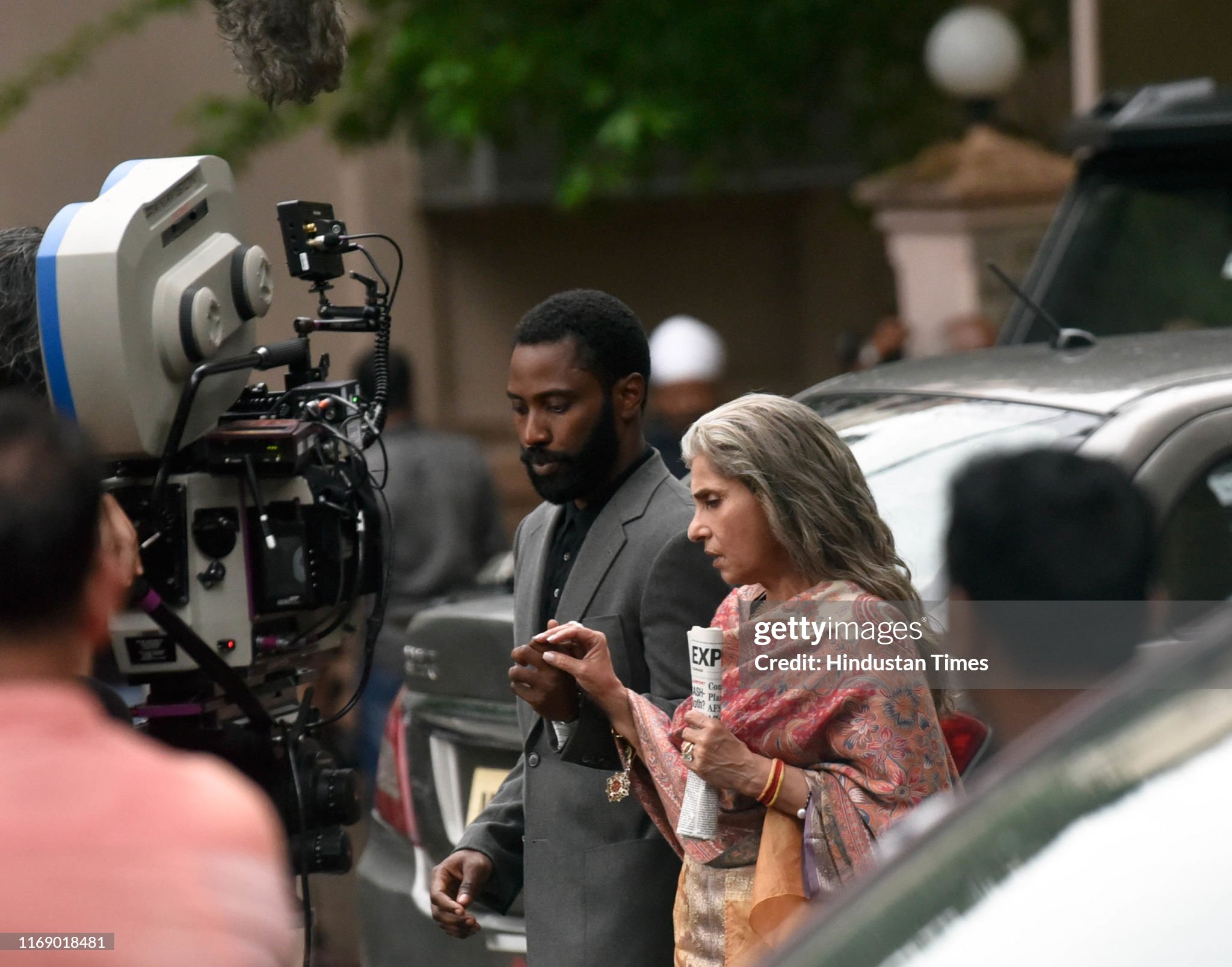
Dimple Kapadia e Christopher Nolan: set di Tenet in Estonia

Dimple Kapadia è stata scritturata per Tenet, il nuovo film di Christopher Nolan. La pellicola verrà girata in diversi Paesi, fra cui l'Italia. La troupe è attualmente in Estonia. Nelle due fotografie diffuse in rete, l'attrice e il regista sono immortalati sul set allestito in questi giorni per l'appunto in Estonia.

Aggiornamento del 26 agosto 2020: a partire da oggi Tenet è in distribuzione nelle sale italiane.


Dimple Kapadia e John David Washington, set a Mumbai, settembre 2019


12 marzo 2013

Steven Spielberg a Mumbai

Reliance Entertainment ha organizzato un evento imperdibile, svoltosi ieri sera a Mumbai, che ha riunito sotto lo stesso tetto in un colpo solo un nutrito numero di registi indiani, accorsi ad ascoltare la conversazione fra Amitabh Bachchan e Steven Spielberg. Ne cito alcuni: Rakeysh Omprakash Mehra, Shyam Benegal, Rajkumar Hirani, Madhur Bhandarkar, Anurag Kashyap, Ashutosh Gowariker, Kunal Kohli, Nagesh Kukunoor, Sudhir Mishra, Zoya Akhtar, R. Balki e Vikramaditya Motwane. 
Vi segnalo l'articolo Steven Spielberg’s close encounter with Bollywood, di Nyay Bhushan, pubblicato ieri da The Hollywood Reporter:
'Bachchan then asked Spielberg if he had any questions for the Indian film fraternity present. Spielberg took the chance to do a spot poll and asked how many directors present did action movies (not too many hands went up), comedies (some hands) and musicals (the hall erupted in laughter given Bollywood is driven by song and dance). “I’d like to know what kind of movies are made, not just Bollywood. Is there freedom here for different genres?” asked Spielberg. “It is getting better,” replied Sudhir Mishra. “Audiences are also changing and there is a new breed of directors, and many of them are in this room. And even mainstream cinema is changing.” As Mishra pointed to director Raju Hirani, known for the superhit comedy 3 Idiots, Spielberg said, “Yes, I saw it - I loved it”.' 
Video Reliance Entertainment  
Per stasera è in programma un party esclusivo in onore di Spielberg, a cui parteciperanno, fra gli altri, Aishwarya Rai, Farhan e Zoya Akhtar, Preity Zinta, Sridevi, Hrithik Roshan, Anushka Sharma, Ashutosh Gowariker, Karan Johar, Kajol, Anil Kapoor, Rishi Kapoor, Anupam Kher, Kamal Haasan e Rajkumar Hirani. Vi ricordo che Reliance e Spielberg hanno prodotto insieme Le avventure di Tintin e Lincoln.


Rajkumar Hirani e Steven Spielberg

Madhur Bhandarkar e Steven Spielberg


9 novembre 2012

Irrfan Khan: Khan rises in the West

Vi segnalo l'intervista concessa da Irrfan Khan a Sudhish Kamath, pubblicata da The Hindu il 2 novembre 2012. Khan rises in the West:

'How are you enjoying your stint with Hollywood?
I have to restrain myself, resist the temptation because I keep getting all kinds of films from Hollywood. Because my survival is not based out of Hollywood. So this is a very privileged position for me. I do films sometimes for survival in India. I choose projects in Hollywood that are challenging... that have something new to offer to me. Whether it is The Namesake or In Treatment... If I have to define In Treatment, it was not TV, it was not theatre, it was not cinema... It was something else. I look for challenges and areas that I haven’t got a chance to explore with Hollywood.
So do you work with a different kind of remuneration with Hollywood to be able to do these roles?
Remuneration is not very lucrative for me. It’s not even one-fourth of what I get in India. Just because you see them making multi-million dollar films, it does not mean they will pay Irrfan Khan millions of dollars. The film business is run in a way that you get paid according to whatever your importance is. (...)
How has your understanding of cinema changed over the years?
When I came into cinema, I was mesmerised by a few actors and when I saw them, I thought they were experiencing something special. That’s what attracted me to films. Initially, it was more about fame. But later it changed. Fame is just an ego-massaging exercise. I’m fortunate to be in this line. I’m in a medium where I can connect with a person who doesn’t understand a single word of the language I speak. But he’s touched by my performance. I become a part of his emotional psyche. And that’s the kind of ability you have as an actor.
So Life Of Pi was one such experience?
No, that was my journey before Life Of Pi. The challenges in Life Of Pi were completely different, something I have never experienced as an actor. The film is dealing with complicated issues. Whoever wants to look at these issues would interpret them in their own way. It will entertain a child who is watching as much as it will entertain an intellectual person. This film will leave you with so many interpretations. And it cannot be achieved unless and until you are aware of it. You have to work towards it. That was the challenge.
What was the biggest take-home for you from Life Of Pi?
Watching Ang. The way he conducts himself, his personality... If you see him, it seems like he has just eliminated all the unnecessary things from his personality... you don’t see a kind of baggage that you would expect from one of the most important directors of our times. The way he’s passionate about his work, the way he is so concerned and very personal. He’s available to everybody and at the same time, also keeps to himself.
What kind of roles are you looking at doing here post Paan Singh Tomar here?
I am getting more or less the same kind of roles. I am looking at films that are different yet have the ability to make money. All things in this world are a product of contradictions. Like art and commerce. Even in life, there are two opposite forces that are colliding all the time in our universe. And something new emerges when they collide.
Are you excited and confident that films such as Paan Singh Tomar are getting recognised today?
I was confident even 10 to 12 years ago when I did Haasil. I knew people wanted to see something different. They wanted films where entertainment would be redefined. The entertainment industry cannot afford to keep repeating a formula. It needs to keep evolving and redefining itself. Am I pushing the boundaries? Is it good for cinema? Is it entertaining and engaging? Is it suited for cinema or better suited for a book or news? Is it smuggling the issues smartly enough without being in your face? These are things I look for when I choose films'.

Irrfan Khan: Everything has come to me late in my life

Vi segnalo l'intervista concessa da Irrfan Khan a Garima Sharma, pubblicata da The Times of India il 24 ottobre 2012. Everything has come to me late in my life: Irrfan:

'In all honesty, with the international recognition that has come to you post Slumdog Millionaire, there must have been some point when success went to your head?
If success would have come early in life, it would have. But, everything came to me a little late. It’s a pattern with me - things always come late to me. When I was doing TV, I longed to do films. I was even ready to become a henchman. At that time, if I would’ve got the role of a villain, I would’ve wasted my life just playing villains. But, I think destiny is taking care of me, even if it is giving me things later in life, even if it is testing me. I have never been in a situation where success could go to my head.
Has Hollywood impacted your Bollywood prospects?
An actor looks for recognition. And when you do work like this, it creates a perception about you in the audience’s mind. That’s it. But, it gives me a choice to do stories which I would’ve never got here. I would’ve never got those directors and stories to explore here. I don’t want to find a formula for success and keep repeating that. (...)
You don’t get such work in Bollywood?
They don’t ask variety from you. I am just fortunate that I don’t need to, for my bread and butter, depend on Hollywood. For me, it’s a luxury. I choose films, which give me what I am looking for. That’s why I am not living in Hollywood. If I go and stay there, I would be shooting all year long. But I don’t want to do that. For me, as an actor, I need challenges where you can trust your director and take a plunge. It’s exactly like Pi, who has been thrown in this sea with these animals, and he doesn’t even know how to row a boat and he has to find his shore.
How important is Bollywood to you today?
It’s very important because that’s where I earn my living from. This industry is everything to me. When I dreamt of becoming an actor, I thought of being popular in India and not anywhere else.
Cliched as it gets, was the role of Pi the toughest of your career?
Yes. The contract just said they needed 10 days from me. But, you can’t ask them, ‘No, I have to prepare for two months or three months, so you pay me for that’. It was literally only 10 days of work, but it took me so many months of preparation. Ang was also exploring it with me, so initially he told me to find a French-Canadian-Indian accent. I kept trying for months, and it was really torturous, and finally he chose not to use that! But, it was an experience that I learnt a lot from. This is one of my most challenging roles, even though it may not be that much on screen. I did stuff earlier which was mostly for adult audiences. I want to now do films which are for children as well as grown-up audiences. I long to do films, which my children can also watch. Whenever my kids pick up my DVDs, be it The Namesake or Maqbool, they can’t watch those. (...)
It was said that you were unhappy with the way your role turned out in The Amazing Spiderman?
I never said that. Whoever spoke to me, I just said that the director told me what scenes they were eliminating and why they were eliminating, and I had no problem with that. I could understand why they were doing it. They did that even in Slumdog Millionaire, so I had no problem with it. I never said I was unhappy with the role.
After all your preparation, was it easy to understand your director Ang Lee’s vision?
What’s special about Ang is that when he dreams a film, it tries to go deep and find something from it. Relentlessly, he is trying to create something new in his project, to find some relevance in today’s time, and that’s what I call brave. He is a brave person. It’s like there is a playground he is exploring, which he is not very familiar with, but he will take the plunge. When you work with him, you feel like he is trying to pull out something new, something unexplored from the ground, something which people in today’s time can relate to. And yet, with this kind of a story, which is only about an Indian family, he retains all the complexities, and yet tries to give it an international connect. As far as vision goes, it cannot be a like a picture which I show to you and you can understand. He brought his world, I brought mine, I tried to relate to what he was saying and then I poured my entire being into the film. That’s where dynamism comes. That’s what Hollywood understands'.

7 novembre 2012

International Film Festival of India 2012

La 43esima edizione dell'International Film Festival of India si svolgerà a Goa dal 20 al 30 novembre 2012. Il titolo di apertura è Life of Pi di Ang Lee. Nel cast Irrfan Khan, nel ruolo di Pi adulto e quindi del narratore, Tabu e Adil Hussain. Una curiosità: Ayan Khan, il figlio di Irrfan, in Life of Pi interpreta il fratellino di Pi. La pellicola verrà distribuita nelle sale del nostro Paese il 20 dicembre 2012 col titolo Vita di PiTrailer in italiano. Vi segnalo l'intervista concessa da Ang Lee a Karan Johar, pubblicata da Hindustan Times il 4 novembre 2012. Karan Johar interviews Ang Lee:
'Karan: Irrfan and Tabu are established names. Was it interesting to work with them?
Ang: Yes. They have so much respect from me. They are not the ones who said ‘yes’ to everything I said. They always made sure that what they were asked to do was okay. So I told them that it’s India, so you have to let me know. They are established actors. That’s why I don’t have anything to worry about. My main anxiety is that the reading is almost like a fable. I have worked on that story for the film and the script has been romanticised in the end. Since India is not home for me, my main anxiety is how people will receive the movie here. Will they raise their eyebrows or will they adore it? I don’t know'. 
Vedi anche:


Irrfan Khan, Tabu e Ang Lee

4 novembre 2012

Emraan Hashmi signs Danis Tanović's next, Anurag Kashyap to co-produce

Da qualche giorno in India circola una notizia entusiasmante: Emraan Hashmi è stato scritturato da Danis Tanović per il suo prossimo lavoro. Vi segnalo l'articolo Emraan Hashmi signs Danis Tanović’s next, Anurag Kashyap to co-produce, di Prashant Singh, pubblicato da Hindustan Times il primo novembre 2012: 'Anurag [Kashyap], who is responsible for picking Emraan, says, “Kalki [Koechlin] told me how sincere and focused he was during Shanghai. (...) When I saw Shanghai, I loved him, after which I pitched a script to him. He said no, but explained why. I saw in him a person who had no delusions about himself. He knew what he wanted to do.” So, when Anurag got the Bosnian writer-director’s script, he approached Emraan again. “When I read the script, I strongly felt Emraan should do it. But the west doesn’t know him. We also didn’t know whether he would agree. But he said yes. Then we pitched him to Danis, who came to India and met him. Now we’re on,” adds Anurag. Vi ricordo che No man's land, diretto da Tanović, nel 2002 strappò a Lagaan l'Oscar per il miglior film straniero.
Aggiornamento del 27 luglio 2022: la pellicola in questione è Tigers, proiettata in prima mondiale al Toronto International Film Festival 2014. Nel cast anche Adil Hussain. Tigers non ha mai beneficiato di una regolare distribuzione nelle sale, sembra a causa dell'argomento trattato: la storia si ispira allo scandalo che coinvolse la Nestlé negli anni settanta del secolo scorso, scandalo riguardante la commercializzazione di latte in polvere nei Paesi economicamente disagiati. Nel 2018 è stato diffuso in streaming. Trailer. In Italia è stato proiettato al Trieste Film Festival 2015. Vi segnalo l'articolo Danis Tanović contro Big Pharma e Nestlé nel suo thriller etico "Tigers", di Paolo Russo, pubblicato da La Repubblica il 6 marzo 2015:

'[Danis Tanović] “Finché a Venezia incontrai Anurag Kashyap (...) e quando gli dissi della sceneggiatura (...) che però nessuno era tanto folle da produrre, lui mi indicò Guneet Monga (...) dicendo ‘se c’è una così pazza da farlo è lei’. E così ce l’abbiamo fatta”. 
Emraan Hashmi, da Bollywood all’impegno
Ne è venuta fuori una produzione anglo-franco-bosniaco-indiana di tutto rispetto. Girata in India, Germania e Inghilterra. (...) Ed ecco (...) la bella perché autentica colonna sonora di Pritam, (...) e la presenza nell’ottimo cast di Emraan Hashmi, giovane idolo di Bollywood al debutto in un ruolo impegnato, che ha saputo virare ottimamente il suo charme di “serial kisser”, così lo chiamano a casa, nelle facce ora grintose ora disperate, speranzose o distrutte di Ayan [il protagonista]. (...) Una storia complessa per un film altrettanto complesso, che nella sua struttura a scatole cinesi ne contiene altre mille. Una tragedia immane che Tanović accosta assai bene, però privilegiandola, alle vicende personali dei tanti personaggi coinvolti a partire da Ayan. (...) Del quale il film rivela la pur temporanea adesione alla militare aggressività di certa cultura aziendale in nome del proprio riscatto economico, il suo terrestre vacillare davanti alla mazzetta Nestlé, facendone così un uomo fallibile, salvato però da una solida, laica pietas, e non l’eroe che ci si poteva aspettare. E come resistere alla dolcezza della sua arcaica, adorabile famiglia che vede sempre uniti, a dispetto della tremenda situazione, il vecchio padre saggio, testardo e di solida, tenera umanità, la madre gioiosa e inesauribile, la giovane moglie, bella quanto coraggiosa e incorruttibile.
Un avvincente thriller etico 
Scritto con sagacia, girato per lo più in piani medi e americani, spesso addosso ai protagonisti, alternando inquadrature di gran pregio (su tutte la sequenza del matrimonio di Ayan) (...) ad altre anonime, brutali, montato con esemplari cambi di ritmo, capace di dare ugual profondità ai cattivi come ai buoni, Tigers è un avvincente thriller etico. Un documentario in noir nel quale investigazione e ricerca del colpevole scandiscono le tappe dell’estenuante catarsi di Ayan, (...) piccolo uomo con poche chance, della condanna senz’appello dei potenti occidentali e dei loro sicari pakistani. Addestrati, come si vede nel film, da un molto americano manager-marine ad aggredire mercato e concorrenti ruggendo come le tigri del titolo. Mostra, il film, con fermezza che basta a se stessa, la palude di corruzione e speculazione che della sciagura di tanti piccoli innocenti continua a fare la fortuna dei già fantascientifici bilanci di Big Pharma. (...) Malgrado i successi di critica, Tigers - vale ripeterlo: un magnifico film anche in senso squisitamente cinematografico - (...) [è] ancora in attesa, da noi per certo, probabilmente pure altrove, di un distributore. Perché il cinema, per esser fatto ma anche fatto vedere, ha bisogno di coraggio'.

12 giugno 2012

Marc Webb: Irrfan Khan has a very commanding presence

Irrfan Khan in The Amazing Spider-Man
The Amazing Spider-Man verrà distribuito nelle sale indiane il 29 giugno 2012, una settimana prima rispetto agli Stati Uniti. Vi segnalo l'articolo Irrfan has a very commanding presence: ‘Spider-Man’ director, pubblicato oggi da The Indian Express, che raccoglie alcune dichiarazioni di Marc Webb: 'I have been an enormous fan of Irrfan for a very long time. I first saw him in The namesake, The warrior and in TV series In treatment. For Dr. Ratha, I needed someone who projected sophistication, had lot of strength and a very commanding presence and Irrfan fit that bill. He is in the first half of the film and in several scenes. (...) I would not call his character a good guy or the bad guy, I would say he has a job to do and he has started about doing it. (...) Dr. Ratha works in Oscorp, the company owned by previous villain Norman Osborn. Irrfan plays the boss of Dr. Curt Conner. He plays an important role in Conner's transformation as villain 'The Lizard'. Irrfan provides the pressure'.
Il 12 marzo 2012 Renuka Vyavahare aveva riportato altre dichiarazioni sull'argomento rilasciate da Webb, pubblicate da The Times of India. Irrfan Khan has wonderful abilities: Mark Webb: 'Irrfan's importance in Hollywood is an interesting thing. A lot of directors are really starting to take notice of him and are looking for roles for Irrfan because he's got such a wonderful reputation. There’s a show he did here [in the US] called “In Treatment” and you really got to see his wonderful abilities. Whether its Danny Boyle or Ang Lee, really very strong directors are starting to take notice of this star who comes from a land that some view as exotic and far away from us. But you realize with actors like Irrfan, how close they really are. (...) Irrfan, it’s good to see you again. I hope you’re doing well and my best to you and your family”.'