8 giugno 2012

Vishwaroopam: locandine e trailer

Kamal Haasan collabora alla sceneggiatura e alla produzione, dirige e interpreta Vishwaroopam, film tamil d'azione. Nel cast anche Rahul Bose. Il regista Shekhar Kapur regala un cameo. La colonna sonora è composta dal trio Shankar-Ehsaan-Loy. La pellicola viene realizzata simultaneamente in lingua hindi, col titolo Vishwaroop, e ad oggi è una delle più costose nella storia del cinema indiano. Molte le location straniere, fra cui il Canada e gli Stati Uniti. Trailer.

5 giugno 2012

Southscope Giugno 2012: Karthi Sivakumar

Il numero di Southscope di giugno di regala un sorridente, e sempre adorabile, Karthi Sivakumar. Il fratello minore della star Surya  in pochi anni è riuscito a collezionare un'invidiabile lista di successi tra cui Naan Mahaan Alla, ParutiVeeran e Paiyaa. Nel 2011 Karthi ha interpretato il primo remake del telugu Vikramarkudu (Siruthai) nuovamente portato sullo schermo da Akshay Kumar  (Rowdy Rathore). Dopo un lunghissimo anno sabbatico finalmente il pubblico può festeggiare il ritorno di uno degli volti più amati del cinema tamil, sta infatti uscendo il suo nuovo lavoro, Saguni, il cartellone per il prossimo 06 luglio.

4 giugno 2012

Le prime dell'8 giugno 2012: Shanghai

Shanghai si preannuncia uno dei film più interessanti del 2012. Diretto dal talentuoso Dibakar Banerjee, è un thriller a sfondo politico, adattamento cinematografico di Z, romanzo del 1966 dello scrittore greco Vassilis Vassilikos. Dibakar ha lavorato per un anno e mezzo al progetto. I produttori hanno incontrato Vassilikos, il quale si è mostrato molto sorpreso ma soddisfatto della sceneggiatura. Il cast è di quelli da perderci il sonno. Abhay Deol, Kalki Koechlin, Emraan Hashmi e la superstar bengali Prosenjit Chatterjee, insieme sul grande schermo, costituiscono una golosità per veri appassionati di cinema indiano. Vishal-Shekhar firmano l'intrigante colonna sonora, che include anche un'item song, Imported Kamariya, visualizzata dalla modella britannica Scarlett Mellish Wilson. Il brano Bharat Mata Ki Jai vanta un testo redatto dallo stesso Banerjee, e in India ha suscitato un vespaio. Vi segnalo inoltre Khudaaya, Duaa, e Morcha. Trailer.

Aggiornamenti dell'8 giugno 2012:
- recensione di Raja Sen, Rediff, ****: 'At first glance, the irony is staggering. A country pretending to be another, brighter country, being shown up by a film that itself borrows form and content from another country. Yet so strident is Dibakar Banerjee's voice as a filmmaker that even this adaptation (...) is turned into a strikingly relevant story of our times and our crimes. (...) Banerjee's genius has always been most visible in his meticulous detailing, and this latest film is expectedly crammed with beautiful nuance. (...) The little touches are smashing, fleshing out most of the characters and making them into more than words and actors. Yet what words, what actors. Emraan Hashmi (...) delivers a knockout punch as he masters a complicated role. From his infuriatingly goofy laugh to poor attempts at making conversation, Hashmi proves himself the best of a very fine ensemble. (...) It's one of the best performances from one of our leading men in quite some time. (...) Bravo. (...) Banerjee must be lauded for not dumbing things down and creating a mature, serious film that engages, thrills and amuses. (...) Shanghai is all Dibakar, who we must lift on our shoulders with grateful pride. And we must exult in the fact that this D is never silent'.
- recensione di Mayank Shekhar: 'A picture that strikingly captures the chaos and curfews of middle India, (...) exposing the rule of the mob where democracy is merely centred on state-craft and elections, as against statesmanship or equality. (...) The first Indian mainstream film (...) to dig into the protocols and plotting that greases the wheels of Indian civil services. (...) We complain about the system quite often. Well, this is the system. Civil servants over time become minor mimics of the looting political masters they salute to. (...) A gritty drama, just as amusing as it is disturbing. Between artistry and analysis, Dibakar Bannerjee, without doubt the most exciting filmmaker around, chooses to entertain first. (...) Still, in its breathless pace, the narrative either skims over or completely overlooks several nuances and facets of Indian democracy that would play key roles in a high-profile case such as this. (...) Banerjee smartly finds in the book the compelling central conflict of rising India: displacement of poor locals versus development for richer millions; people’s empowerment versus nation’s economic growth. Neither side can be ignored. India, at present, houses the world’s largest number of people displaced for development projects. Not all of this movement could’ve been fair. (...) This is that important, universal story of modern India, interestingly told, enticingly captured. It must be watched, and relished, for sure'.

Aggiornamento del 12 giugno 2012 - Meet the spanking new Emraan Hashmi!, Shelly Walia, Rediff:
'"The film gives you a goodbye gift. One gets engaged and entertained while watching it, but in retrospect, you realise you are carrying with you a meaning, a message, a reality," says Banerjee. (...) "Abhay's role as a typical Tamilian bureaucrat did not come easy. The character is the voice of the establishment and has power, but is conservative. His character has shades of grey, which keep the audience guessing. To get the accent right, he had to undergo a month-long language workshop where he learnt to speak English and Hindi with a Tamil twang," says Banerjee. Deol also trained himself with the IAS [Indian Administrative Service] machinery to get the body language and the stern expression correct. "He plays a character much older than his real self. He needed to walk with a slight stoop, as someone who has led a sedentary life of working on the laptop for long hours," Banerjee adds.
For Hashmi's character, Banerjee needed an actor with whom the audience would connect. "Jogi is a street-smart cameraperson and part-time porn filmmaker. We researched quite a bit on porn filmmaking. The character had to appear dirty and sleazy, so we made him gain 10 kg. He had to have a paunch, blackened teeth and a darker complexion. He also took dancing lessons. Everything about him is in stark contrast to his earlier image," Banerjee says. (...)
Like Banerjee, Hashmi too steps into unexplored territory with Shanghai. A step away from the Mahesh Bhatt camp (most of his successful films have so far been with Bhatt) and in the midst of an offbeat cast, the actor outshines everybody else. But experts don't think this will do much to change his "lover boy" image. Hashmi today is the example of a successful actor with several box office hits, but one who has not been offered any brands to endorse. Brand strategy specialist Harish Bijoor says, "The movie will not help Hashmi in an image makeover, despite this being an out-of-the-box role for him. Brand advertisements are all related to happy stars." (...) John Abraham's happy-go-lucky image works well for him in the advertising space, though he is not as successful at the box office, Bijoor says. Brand expert Gullu Sen says that the Indian consumer is still very conservative. "It took Salman Khan years to rebuild his image. For Hashmi this must be a beginning, but there is a long way to go before he starts endorsing brands".'

Aggiornamento del 16 luglio 2012: ieri Shanghai è stato proiettato a Baghdad, alla presenza di Safia Taleb Ali al-Suhail, membro del parlamento iracheno, e del politico indiano Suresh Reddy. L'evento è stato organizzato a ridosso  della zona internazionale della città. La corrente elettrica è mancata un paio di volte, ma pare che il pubblico presente in sala - soldati compresi - abbia comunque apprezzato la pellicola. Shanghai è il primo film indiano proiettato in Iraq negli ultimi vent'anni.

Vedi anche:
The Dibakarian way of life, 18 aprile 2022

Bollywood su Rai Movie: ciclo 2012

Da domani 5 giugno e sino al 4 settembre 2012, ogni martedì sera alle ore 21.00 Rai Movie proporrà un film hindi. Si parte con Kuch Naa Kaho (Un padre per mio figlio). Fra gli altri titoli: Aap Ki Khatir (Un fidanzato in affitto) il 12 giugno, Swades (Una luce dal passato) il 19 giugno, Thoda Pyaar Thoda Magic (Un pizzico d'amore e di magia) il 26 giugno, Kabhi Alvida Naa Kehna (Non dire mai addio) il 3 luglio. In programma anche Jodhaa Akbar (La sposa dell'imperatore) e Nanhe Jaisalmer (È tempo di sognare). Preciso che sono tutti titoli proposti da Rai 1 negli ultimi quattro anni. In prima visione sono in programma Rab Ne Bana Di Jodi (Un incontro voluto dal cielo) e Guru. Vi segnalo inoltre Nirakazhcha (La strada dei colori), in lingua malayalam, di Anish J. Karrinad, con Vincenzo Bocciarelli; nonché La maga delle spezie, produzione internazionale con Aishwarya Rai. Vi ricordo che lo scorso febbraio e lo scorso marzo Rai 4 aveva sorprendentemente presentato - in versione direi integrale - il mitico Dabangg.
Vedi anche:
- Bollywood: 100 di questi anni, 8 giugno 2013, ciclo 2013 su Rai 1 e su Rai Movie.

3 giugno 2012

Bollywood's 100 crore club

Vi segnalo l'articolo Bollywood's 100 crore club, di Komal Nahta, pubblicato oggi da Brunch. L'articolo illustra il favoloso 100 crore club, ossia il ristretto gruppo di star di sesso maschile i cui film hanno incassato, nella sola India, 100 crore (1 crore = 10 milioni) al botteghino al netto delle imposte. Aamir Khan è stato il fondatore, nel 2008, grazie a Ghajini (115 crore), e nel 2009 superò se stesso con 3 idiots (202 crore) - non è stato ancora istituito il 200 crore club perché nessun  altro titolo si è neppure avvicinato a quel vertiginoso successo. Salman Khan è il membro col maggior numero di trofei: entrò nel club nel 2010 con Dabangg (143 crore), e replicò nel 2011 con Ready (122 crore) e Bodyguard (145 crore). Inoltre Salman ha raggiunto i 100 crore più velocemente degli altri: Bodyguard li incassò in una settimana. Nel 2010 fece il suo ingresso anche Ajay Devgan: Golmaal 3 (108 crore). La star consolidò la sua posizione nel 2011 con Singham (100 crore). Nel 2011 toccò a Shah Rukh Khan: Ra.One (115 crore) e Don 2 (110). Nel 2012 è la volta di Hrithik Roshan con Agneepath (122 crore) e di Akshay Kumar con Housefull 2 (112 crore).


'Getting into the 100-crore club is not as simple as being in a movie that has rung up Rs 100 crore. To be considered for entry, a film must have made that gigantic amount in net collections, not gross. For the uninitiated, gross collection of a film is the sum total of the money which is collected at all the ticket counters of cinemas across the country screening that film. Net collection is what remains in the film industry’s hands after paying off the entertainment tax to the different state governments. 
Membership can’t come on the strength of a film’s overseas success either. Otherwise Shah Rukh Khan would’ve been the club’s founder member. 
The public may have its own definition of hits and flops, but the film industry has always gone by the cost-versus-revenue analysis to determine success (it is also the only objective way of defining hits and flops). A number of avenues of revenue now exist for a producer in addition to a theatre screening. But it is a generally accepted principle in the film trade that income from most of the other sources like satellite television, home video, etc depends largely on the earnings from the theatrical business of a film. 
The 100-crore club does not take into account the cost of a film as it goes solely by revenue. It is for this reason that Shah Rukh Khan, with Ra.One (total cost Rs 150 crore approx) [e soli 115 di incasso], (...) is as entitled to club membership as Aamir Khan, with a blockbuster like 3 idiots (total cost Rs 55 crore approx). (...)

Some basic club rules: 
You must be a star to be eligible for membership. The club does not recognise any other community - neither producers and directors nor distributors.
You must be saleable, since only stars whose films collect Rs 100 crore or more can join the club. (These are net collections, not gross. Net collections are defined as total box-office collections - that is, gross collections minus the entertainment tax). Their saleability is of paramount importance. It is measured in terms of how much money their films make. (...) 

No woman no cry
Only male stars are members of the club so far. To understand why no actress is a member, it must be understood that the club has, after all, been ‘formed’ by the trade and the media. And excluding women from the group is characteristic of an industry which exercises gender discrimination more than other industries. You may have heard of producers paying Akshay Kumar and Salman Khan fees of Rs 20 or Rs 25 crore but have you ever heard of an Aishwarya Rai or a Kareena Kapoor getting that kind of remuneration? Frankly, the industry can’t be wholly blamed for the gender bias because it is the audience which gives male actors far more importance than female stars, the occasional Vidya Balan film notwithstanding. 
In commercial potboilers (which are the only films capable of catapulting their heroes into the club), heroines get far less scope than the heroes, which is the reason why the club membership has so far been restricted to male actors. (...)
An interesting aside: Kareena Kapoor has the maximum number of 100-crore films under her belt, more than even Salman Khan. Kareena’s report card reads: 3 idiots, Golmaal 3, Bodyguard and Ra.One. Unfortunately, as the club is not open to heroines, Kareena is a non-member despite her enviable score.
Even among the male stars, it is only the main leads who are considered worthy of membership. (...)

Star power
Interestingly, although it is the film which touches the 100-crore mark, it is the star who gets membership of the club. This is another indicator of how stars are worshipped by the industry. Bollywood has always been a star-driven enterprise and it is not uncommon for stars to hog the limelight for a hit. (...)
Most of the Rs 100-crore films have worked equally well in multiplexes and single-screen cinemas. Perhaps Don 2 is the only exception because it scored largely in the cineplexes. But unlike most other 100-crore-films, Don 2 had the brand advantage since it was a sequel. Golmaal 3 had a similar brand value even though the previous two films were not half as big or successful. Agneepath had tremendous recall value because of the 1990 version of Agneepath starring Amitabh Bachchan (despite the fact that the first one was a box office debacle and became a cult classic only much later on TV and DVD).
Although there is no time frame, films normally touch the 100-crore figure in two to four weeks. Today, the business of films has become touch-and-go. Most hits have a run of only four to six weeks. Among the stars who are members of the club, Salman Khan holds the distinction of touching the 100-crore mark in the shortest possible time (Bodyguard, one week!)'.

2 giugno 2012

Hay Festival of Literature and Arts 2012

La 25esima edizione dell'Hay Festival of Literature and Arts si svolge dal 31 maggio al 10 giugno 2012 nella città dei libri: Hay-on Wye, nel Galles. La manifestazione prevede una rassegna cinematografica che include i seguenti titoli indiani: Rang De Basanti (Soha Ali Khan presente alla proiezione), Khosla Ka Ghosla (Anupam Kher presente alla proiezione), Firaaq (Nandita Das presente alla proiezione). In programma anche un incontro con Deepa Mehta e Salman Rushdie che discuteranno dell'adattamento cinematografico de I figli della mezzanotte.

Salman Rushdie e Deepa Mehta, Hay-on Wye 2012

Hero, anti-hero, zero

Vi segnalo l'articolo Hero, anti-hero, zero, pubblicato oggi da The Times of India. L'articolo ripercorre la storia della caratterizzazione del protagonista maschile nella cinematografia hindi dagli anni cinquanta ad oggi.

30 maggio 2012

Why America loves brain-dead Bollywood

Vi segnalo l'articolo My favourite bimbo: Why America loves brain-dead Bollywood, di Lakshmi Chaudhry, pubblicato da Firstpost il 23 maggio 2012: 'Our movies are newly beloved precisely because they are seen not as great cinema but as a cultural experience of the wild, wild East. (...) Finally, commercial Hindi movies are getting the respect they deserve... Well, 'respect' may be the wrong word. Bollywood is now the official bimbo of the international film scene. No one cares what our movies say as long as they look good and offer mindless fun. In fact, that’s our designated job according the kitsch-is-cool pose adopted by American critics. Cartoonish characters, absurd plotlines and bad dialogue? Thank you, that’s exactly what we ordered, with a giant serving of exotic locales, dance numbers, and costumes, please! (...) In American eyes, Bollywood becomes the cinematic equivalent of going to the circus. (...) Indian cinema suffers from what George Bush once described as 'the soft bigotry of low expectations'. (...) The underlying message is that 'serious' cinema is best left to those who know how - in Hollywood, France, even Iran. Our job on the international cinema stage is simple: look pretty and play dumb.'

Moondram Pirai / Sadma : Recensione


[Blog] Recensione di Moondram Pirai (tamil) e Sadma (hindi), due versioni ugualmente belle dello stesso film. Con Kamal Haasan, Sridevi e Silk Smitha.

28 maggio 2012

Awaara entra nella Top 100 di Time

Richard Corliss ha aggiornato con venti nuovi titoli la lista dei 100 migliori film selezionati da Time, lista compilata a partire dal 1923, anno di nascita della rivista. Awaara di Raj Kapoor è fra questi. Nella motivazione si legge: 'Raj Kapoor was the great star-auteur of India’s postcolonial golden age of movies - Cary Grant and Cecil B. DeMille in one handsome package. The ’50s films he headlined and directed became huge hits not just in his newly freed homeland but also across the Arab crescent from Indonesia to North Africa. Kapoor, who modeled his screen persona on Charlie Chaplin’s Little Tramp, was 26 when he filmed Awaara (The Tramp). A pompous judge (Kapoor’s father Prithviraj) disowns his wife (all-time Indian cinema mom Leela Chitnis) when some months after being kidnapped she returns pregnant; his baseless suspicion is that the bandit she’s been with is the father. In ignominy and in secret, she bears the judge’s son (Kapoor), who is raised a vagabond and, decades later, goes on trial before the judge. Sensational revelations! As Kapoor sees it, the wellspring of these torrents of guilt is a society divided into Brahmins and outcasts. Beyond the social finger-pointing, Awaara is a glistening showcase for Kapoor and the great India siren Nargis (his lover onscreen and off); it features a sadistic-sexy beach scene and a dream sequence that starts in delirium and revs up to delicious. And of course it’s a musical, whose main song, “Awaara Hoon,” by the famed Shankar-Jaikishan duo, soared to the top of the pop charts in India, the U.S.S.R. and China'.

27 maggio 2012

It's crime time for small screen

The Times of India pubblica oggi un articolo, It's crime time for small screen, di Saloni Bhatia, dedicato alle trasmissioni televisive hindi che trattano temi di cronaca nera e che appassionano un numero sempre maggiore di spettatori. Negli ultimi mesi i fatti di cronaca, dagli abituali canali di informazione, sono debordati anche in quelli di intrattenimento. Fra i programmi più famosi: Crime Patrol (Sony), Gumrah (Channel V) e Savdhaan India (Life OK). Quali sono le caratteristiche che accomunano questi programmi? Vanno in onda in seconda serata e trattano - drammatizzandoli - casi di cronaca nera che hanno colpito particolarmente l'opinione pubblica. Il presentatore è di sesso maschile (almeno agli inizi), ha l'aria serissima (e un po' minacciosa), si colloca sempre al centro dello schermo, e illustra il caso con un tono da 'potete evitare che questo fatto accada anche a voi'. Attori semisconosciuti interpretano il caso. Il commento musicale è vagamente bollywoodiano (questo punto suona bizzarro). Non appaiono in studio conduttrici o vallette.
Aggiornamento del 3 maggio 2022:
* Crime Patrol è la trasmissione più longeva della categoria. Nata nel 2003, è tuttora in onda. Fra i conduttori delle varie stagioni, spiccano i nomi di Sonali Kulkarni e Ashutosh Rana.
* Gumrah. End of innocence nasce nel 2012 e si chiude nel 2016. Produce Ekta Kapoor. Fra i presentatori, spicca il nome di Abhay Deol.
* Savdhaan India nasce nel 2012 e si chiude nel 2021 (ad oggi, non vi sono notizie di un'eventuale nuova stagione). Fra i conduttori, spicca il nome di Divya Dutta.

26 maggio 2012

Mohammed Hanif on secrets and lies in Pakistan

Il 24 maggio 2012 Mohammed Hanif è intervenuto ad un programma radiofonico diffuso dal network statunitense NPR. Riporto di seguito alcune sue dichiarazioni raccolte da Steve Inskeep. Mohammed Hanif on secrets and lies in Pakistan:

'The Pakistani writer Mohammed Hanif is living proof that you can sometimes tell the truth more easily with fiction than facts. Hanif is a journalist in one of the world's more dangerous places to be a journalist: Pakistan. He's also become one of the country's most prominent and provocative novelists. His book A Case of Exploding Mangoes told the tale of real-life Pakistani dictator Zia-ul-Haq, who died in a plane crash in 1988. Few believed it was an accident, and Hanif's novel delved into the conspiracies (and conspiracy theories). Hanif joins NPR's Steve Inskeep to discuss the reception of A Case of Exploding Mangoes and his new novel, Our Lady of Alice Bhatti, the story of a poor hospital nurse in the city of Karachi. Interview Highlights:
On choosing to fictionalize Zia-ul-Haq's death
"Like all young reporters, I was like, this is going to be my big story, and I started working on it. After a few months, I realized that there was no way I was going to get to the bottom of it. There were layers and layers and layers of deception and cover-ups to cover the other cover-ups. Then it occurred to me that I would just make up my own facts. If no one was willing to tell me who did it, then as a fictional character, I'll raise my hand and say, 'Well, I did it,' and I'll write a book about it. And so, basically, it was a failed journalist's revenge."
On people accepting his version of events
"The funny thing is, after the book came out, a lot of people - and some of them were heads of intelligence agencies - I've run into them at a party or at a social gathering, and they take me into a corner and say, 'Son, you've written a brilliant novel. Now tell me, who's your source?' I used to find it a bit scary at the beginning that, my God, these people are running my country and they actually believe all the lies that I've written."
On his sympathetic portrayal of Zia-ul-Haq
"Some of my friends - political activists who'd suffered during his regime - they also kind of said, 'You turn him into some kind of Homer Simpson type of character.' But the problem is when you're writing a novel, you spend years and years with these characters, and it's at some point that I think you start to humanize them. You start to internalize their fears and ambitions and - to a certain extent - their cruel streak as well. So I think that probably it is not such a bad thing that if you're going to write a character, you might as well try and get inside his head."
On the heroine of his new novel, Our Lady of Alice Bhatti
"Alice is a beautiful young nurse who has had a troubled past, but she's very feisty, and she falls in love with somebody that she shouldn't have fallen in love with. Basically, I was trying to write it as a love story, but since the love story happens in a particular setting, like many love stories, it goes wrong somewhere."
On his choice of setting (a Christian hospital in Pakistan)
"When I was a teenager and my mother had cancer, she spent her last couple of months in the hospital, which was a bit like this. I spent those months with her and, as you know, public hospitals are strange places - somebody is doing something around the clock, somebody is dying, somebody is in pain, somebody is being born, somebody is being relieved of their pain. So those impressions were very strong in my head, and I think the psychological explanation, now that I think of it, is that maybe I didn't want to focus on my own personal tragedy, which was that my mother was dying. So I was focusing on everything else. And when I was growing up, a lot of nurses in Pakistan - female nurses - happen to be Catholics. It was quite, quite normal. It's only during the last 15-20 years that it has become the kind of profession that men and Muslims and Christians and everybody else goes into that profession. But it started out as a profession for Catholic women in Pakistan.
On depicting women and minorities in Pakistan
When I'm writing a novel - before anything else, I'm interested in Alice the person, Alice the woman - that's what I want to investigate. And by doing that, if I kind of see the glimpse of the kind of surrounding she lives in, if I sort of see a glimpse of the prejudices that she has to face - and mind you, these prejudices are not just because she is Christian, these prejudices are basically because she's a woman, and ever more important, these prejudices exist because she is poor'.

Shekhar Kapur: Mr. India was a product of fearlessness

Anil Kapoor e Sridevi in Mr. India
Ieri Mr. India, secondo film diretto da Shekhar Kapur, ha celebrato i 25 anni dalla sua distribuzione. La pellicola, di genere fantascientifico, conquistò la seconda posizione nella classifica dei maggiori incassi del 1987, ed è considerata a tutti gli effetti un classico del cinema hindi. Interpretato da Anil Kapoor e Sridevi, e prodotto da Boney Kapoor, Mr. India è l'ultimo film sceneggiato dal mitico duo Salim-Javed. Il ruolo dell'antagonista fu assegnato ad Amrish Puri, ed il suo Mogambo è uno dei più famosi eroi negativi di Bollywood. Vi segnalo l'intervista concessa da Shekhar Kapur a Sonil Dedhia, pubblicata ieri da Rediff. Mr. India was a product of fearlessness:

'When you think of Mr. India now, what are the images and memories that flash through your mind?
It was very tough and at the same time so much fun to make Mr. India. It was tough because we did not have the tools and the technology available today. It was not possible to add the visual effects during post-production as it happens today. We had to shoot everything on camera, so the time and effort taken was really challenging. The great thing about Mr. India was... I relied on all the actors to take the attention away from the visual effects. The visual effects were fundamentally sold by the performances of the actors. What has turned out in the last 25 years is it's not the visual effects but the characters that have stayed with the audience. It's always important for me that the actors and characters are what make my films... In a way I thank god that we didn't have advanced technology because the characters in Mr. India created the awe factor of visual effects.
The film took major inspiration from H.G. Wells's The Invisible Man. Even before Mr. India was made, we had films like Mr. X (released in 1957 starring Ashok Kumar) and Mr. X In Bombay (released in 1964 starring Kishore Kumar) on similar lines. Had you read the book or seen the films?
I never saw them and I haven't seen them. Actually, I should watch it. I never found a copy of any of these films. One day I asked Boney Kapoor to get me a book, and he got me The Invisible Man and the book was about editing (laughs). The inspiration for the film actually came from the story written by Salim-Javed (Salim Khan and Javed Akhtar). (...)
Do you remember the first time you read the script?
What I first heard about Mr. India, it was just an idea. It took a long time to develop the story. The funny thing is that we had already started shooting for the film and Javed Akhtar was still writing the character of Mogambo (laughs). (...)
What would you say makes Mr. India such a great film?
I think there was something very special that we discovered when we made the film. It was fearlessness. I shot the film completely instinctively. Boney Kapoor was a fearless producer. He was one of the great independent producers of his time. During its time Mr. India was a very expensive film. Anil Kapoor was fearless and so was I. The film was a product of fearlessness from all the people that were associated with it. It was not that we were never afraid, but we were on a roll. We all supported each other. When you see the film today, you can sense that adventure and the joy of filmmaking.
Did this fearless attitude come from the fact that you were just one film old then and the producer too was at a nascent stage?
I think I agree with you. Fearlessness is an attitude. I came to filmmaking because of the adventure of it. I was a chartered accountant. Sometimes I think I could have been a CEO of a private equity firm or the chairman of a bank, but I chose to be adventurous. If you look at the films that I have made, all have been adventurous. Unless there is a sense of adventure, I don't make a film.
Were you at any point of time unsure about Mr. India's success?
Never. I was passionate about making Mr. India and there are no two ways about it. We all had a lot of arguments. Boney would fight with Javed. I would fight with Boney and it went on. Anil would always stick in the middle. He is a big diplomat. He used to play the role of an arbitrator. I was 100 percent sure about the success of Mr. India. (...)
How easy or difficult was it to release a film in 1987?
It was difficult to make a film, but I think it was very easy to release the film. Unlike today, we didn't have to release the film in 400 screens. I don't remember how many prints we released. Also, we didn't have the fear of video piracy nor was filmmaking a game of weekend business.
How did the industry react to you after the release of Mr. India?
After the film became a success, a lot of people told me to make another film with the children, as I would make a lot of money. The moment someone told me I would make a lot of money, I realised it was a fundamental reason not to make a film, as it is the beginning of making a bad film. I was offered almost every film in town (Laughs). People don't realise how much effort went in making Mr. India. We spent hours on the sets just to hide a wire that held a Coca Cola bottle in mid air. There were hours spent on thinking about the minutest of the details. We didn't even have a green screen (against which you shoot a subject when you want to put your background during post production). In fact, we did one shot on it and it turned out really bad. (...)
Time and again you have said that Mr. India was ahead of its time...
I actually say it as a criticism because I think audiences weren't completely ready for a film like Mr. India. One of the reasons why the film has lasted till today is the simple fact that it was 10 years before its time. If the same film made in the exact manner were released today it would become a huge blockbuster.
In these 25 years, do you think Mr. India has had an impact on the way films are made in India, especially in Bollywood?
I don't think so. If Mr. India had impacted Indian cinema, we would have many more films of that kind and maybe Mr. India wouldn't have sustained its popularity. Mr. India is so popular because it is still one of its kind. Our film was adventurous. We were unafraid when we were making Mr. India. I think 99 percent of the films which have been made or are being made are not very adventurous. People are still afraid of taking risks.
What is happening with Mr. India 2?
I don't know. I have heard that there are intentions to make Mr. India 2. Boney and I have chatted about it a lot of times. I have no idea who is going to direct the film. I have also heard that Salman Khan has been roped in to play a pivotal role, but I don't know anything.
Would you like to direct the sequel?
It all depends on what I am doing at that time. If I am not doing anything, I might think of taking it up. Although my feeling is that there should be a new director because I might tend to repeat myself. A new director might be able to add some freshness to it'. 

23 maggio 2012

Kalki Koechlin: Kissing on screen is not a big deal

Prosenjit Chatterjee e Kalki Koechlin in Shanghai
Vi segnalo l'intervista concessa da Kalki Koechlin a Sonil Dedhia, pubblicata oggi da Rediff. Kissing on screen is not a big deal

'[In Shanghai] You play an Indian girl of mixed parentage who looks like a foreigner. Did your personal experience of growing up in Ooty help you?
Yes. I can definitely relate to my character Shalini's anger in the film. She is a small town girl and the people in the town see her as an outsider just because she looks like a foreigner. Even though she belongs to that town, people don't take her seriously and men try to lech at her. Looking back at my growing up days I can relate to all these things. (...)
Would you say it was an emotionally draining role?
Yes, it is one of the toughest roles that I have played so far. I was rewuired to cry and scream my head off. There are many moments in the film that are really intense. There is a scene in the film where I have to beat someone and it was really tough for me to do. We finished the film in a month. We shot in small towns in Latur and Baramati where there was no proper food or electricity. He [Dibakar Banerjee] almost made me cry during the shoot but I must say that the hard work has paid off.
You are working with Prosenjit [Chatterjee] and Emraan Hashmi for the first time. How was the experience?
I didn't know how big a star Prosenjit was before I worked with him in this film. He made us feel really comfortable. He would hang out with us and we ate together. He was very down to earth. On the other hand, I had an image in my mind about Emraan Hashmi that was very filmy and romantic. He got into his character right on the first day of the workshop. He totally surprised me. He has a great sense of humour.
The kissing scene between you and Prosenjit has been in the news...
Indian cinema is still at an adolescent stage when it comes to kissing or intimate scenes. The ban on kissing scenes in films was lifted in 1980 so it's about time that we get used to it. I don't think it is a big deal, nor do I think about it much. I really don't see it as controversial. The media creates the controversy. I think using the kissing scene in the promotions of the film was inevitable. If we don't use it to promote the film someone else will pick it up.  
There is a very funny incident which took place during the filming of the scene.
Yes, it was a very funny but an intense situation when we were shooting for the scene. Dibakar had given us standing instructions not to stop kissing till he says 'cut'. We started filming the scene and after a while we realised that Dibakar was oblivious to the fact that he had to say 'cut', and instead got busy shooting some other scene! I got very angry with him at that time (Smiles)'.

22 maggio 2012

Vadakkumnadhan - Recensione


[Blog] Recensione di Vadakkumnadhan, complesso dramma psicologico in lingua malayalam interpretato dalla superstar Mohanlal, nel cast anche Padmapriya e Kavya Madhavan. 

The Pope to watch Pankaj Kapur-starrer Dharm!

Pankaj Kapur in Dharm
Vi segnalo l'articolo The Pope to watch Pankaj Kapur-starrer Dharm!, di Subhash K. Jha, pubblicato oggi da Rediff:
'It's decidedly a first at the Vatican. On Tuesday, May 22, Pope Benedict XVI will be watching a Bollywood film, and that too a film that espouses the teachings of Hinduism and propagates the virtues of secularism by showing its rigid Hindu Pundit hero (Pankaj Kapur) embracing an orphaned Muslim child as his own. We're talking about Bhavna Talwar's Dharm that released in 2007.
So what made the Vatican select this film for a screening?
"I don't know!" says the stunned director. (...) "It was done by an Italian friend, a filmmaker named Franco La Cecla, who is close to the Vatican. He thought Dharm is a work that the Pope and the Vatican should see. I think it is the message of the one-ness of humanity which Franco thought would appeal to the Pope."
A print of the film has been sent to the Vatican following a travel plan that included going through the very rigid rules of entry into Vatican City.
"It wasn't easy getting my film to the Vatican City. But it's now all in place," Bhavna says. 
Unfortunately, she cannot be physically present at the screening as she is down with a slipped disc and unable to move for a month.
"It is sad that I am immovable at a time when I would have liked to be present at this historic event," she says. "For me, the most interesting aspect of this event is the way the custodians of one religion have shown a keenness to appreciate art depicting another religion. Dharm is a very Hindu film. But it also shows that every religion is essentially about tolerance and amity. I see no contradiction in the Pope watching Dharm. To be a small part of that movement towards a universal humanity makes me feel proud and humbled at the same time".'

20 maggio 2012

A conversation with urban planner Rahul Mehrotra

Riporto di seguito alcune dichiarazioni rilasciate da Rahul Mehrotra, architetto ed urbanista, nonché docente all'università di Harvard.  L'intervista è stata pubblicata da The New York Times il 17 maggio 2012:
'At the macro level what is happening is very interesting because while the intelligentsia and the élite are focusing on the seven or eight big cities, the real urban time bomb are the 392 towns that make up the larger landscape of India. These 392 towns currently contain approximately 50.000 people each and are projected to grow up to 100.000 people that in 20 years might even be a million people. So potentially between 250 and 400 million urban Indians will live in towns that are not even on radars currently. (...) I think both the architecture and urban landscape of India has to necessarily be one of pluralism because India is a multiethnic, multicultural landscape and I think architecture and cities are the physical expression of those aspirations. I don’t think we can go the China way, where everything is made in a singular image; in the mutinous democracy of India that’s going to be impossible. (...) For me personally, the two most important design moves [a Mumbai] are the sweep of Marine Drive (...) and the other thing that is really emblematic aspect of the city is Dharavi. (...) [Dharavi] it's also emblematic of the real inequities that exist in our cities and that people have to create home for themselves without having their basic needs fulfilled, and a total failure on the part of the government to provide them housing. (...) I think in Mumbai in the 1950s, ’60s and ’70s with ideas for New Bombay and new metropolitan imaginations was all about evolutionary gestures. But today in Mumbai we celebrate involutionary gestures - how we fix sidewalks and upgrade slums. (...) I think the real question for us is what is the appropriate city for our society, our economy, for the kind of inequality that exists. Looking at Dubai or Shanghai or Singapore as metaphors not only undermines the fact that we’re a democracy but it also undermines the fact that the poor even exist in our cities'.

Devudu Chesina Manushulu: le riprese in Italia

In questi giorni si stanno girando in Valle d'Aosta alcune sequenze di Devudu Chesina Manushulu, film in lingua telugu diretto da Puri Jagannadh e interpretato da Ravi Teja e Ileana D'Cruz. Le località prescelte: Aosta (piazza Chanoux, Teatro Romano), i castelli, il Lago Blu, Saint-Vincent, Cervinia, Vetan, Cogne e Courmayeur. La troupe si fermerà nella regione sino al 29 maggio 2012. Le ballerine della scuola Danza & Danza di Vèrres sono state scritturate dalla produzione. Video delle riprese.
Aggiornamento del 30 aprile 2022: trailer. Video dei brani Subba Lakshmi, Nuvvele Nuvvele e Nuvvantey Chala.

Aosta, 2012


19 maggio 2012

Jerry Pinto: Em and the Big Hoom (Il grande Uhm)

Vi segnalo la recensione del romanzo Em and the Big Hoom, di Jerry Pinto. La recensione è firmata da Jai Arjun Singh, e pubblicata da Hindustan Times il 18 maggio 2012:

'The easy way to describe Jerry Pinto’s autobiographical novel is to say that it is a son’s account of life with a mentally unstable mother. Imelda Mendes is called ‘Em’ by her two children, the unnamed narrator and his elder sister Susan. Their father Augustine - affectionate, dependable but taciturn - is ‘the Big Hoom’. (...) The narrator describes their lives with a heartbreaking mix of tenderness and humour. That sounds like a very particular story about a very particular person, but Em and the Big Hoom is much more universal in its appeal. Read carefully and you’ll find that it isn’t just about a “special” mother, it is about parents in a more general sense - parents as the looking glasses that we sometimes recoil from because in their aging faces and increasingly erratic behaviour we see our future selves - as well as a reminder that ‘normalcy’ and ‘madness’ are not airtight categories. 
This gentle, kaleidoscopic narrative is, among other things, a son’s assessment of the long courtship between his parents-to-be, and an attempt to understand what two people he takes for granted might have been like in a very distant time, the Mumbai of the 50s and 60s. (...) It is a litany of candid conversations - not all of them occurring beneath a facade of mental illness - and delightful pen-portraits. (...)
But this is also, in a strange but illuminating way, a book about writers and writing. Much of our understanding of Em’s state of mind comes from her journal entries, reproduced throughout the narrative, and letters such as the meandering one in which she acknowledges the seriousness of her relationship with Augustine. We are told that she was a seemingly effortless writer (...) but also that compulsive writing may be a manifestation of her condition. (...)
Given this, it is notable that the narrator himself tries to fight his genes by seeking refuge in the rigours of writing. “One of the defences I had devised against the possibility of madness was that I would explain every feeling I had to myself, track everything down to its source ... I worked it out on a piece of paper...”. He reaches for ways to convey his feelings about his mother but also recognises the impossibility of the task. (...)
This may help one understand why Pinto - a prolific, busy writer-journalist known for juggling projects with ease - took more than two decades to complete this very personal book (which, he has said in interviews, was originally 10 times its current length). And this brings me to my one quibble about Em and the Big Hoom: the fact that it is presented as a work of fiction. While it works as a novel on its own terms (the writing is consistently vivid and moving enough to appeal to a reader who approaches it as a made-up story), I think it works even better if you know who the narrator is, and what his own writing life has been like. I don’t usually spend time dwelling on how ‘autobiographical’ a novel is, but I felt it mattered here: speaking as a reader-writer envious of the quality and range of Pinto’s work, this book seems to reveal much about his own imperatives. Trivial though this might sound - and largely unconnected with the actual quality of the writing - I wish it had ‘memoir’ rather than ‘fiction’ printed on its jacket flap'.


Aggiornamento del 29 aprile 2022: nel 2016 Salani Editore ha pubblicato la traduzione italiana, intitolata Il grande Uhm. Nel sito dell'editore si legge: 'Un racconto appassionato e divertente sull’educazione sentimentale di un ragazzo, ma anche sulla vita di una famiglia divisa tra due poli, Uhm, ‘la mia roccia e il mio rifugio’, e lei, Em, madre dolcissima e molto intelligente, sboccata come un’adolescente, disinibita nella sua follia. Una vita sospesa tra pazzia e normalità, tra la lucidità dell’amore quotidiano e il tentativo di raggiungere Em oltre le nebbie della malattia. Una narrazione vivace e profonda, che riesce a superare ogni difficoltà per guardare avanti, in bilico tra il dramma e la comicità involontaria scatenata dalla vita'.

18 maggio 2012

Yash Raj Films produce Grace of Monaco

La filiale americana di Yash Raj Films, gestita da Uday Chopra, coprodurrà il film Grace di Monaco, diretto da Olivier Dahan e interpretato da Nicole Kidman. Chopra ha commentato: 'Grace of Monaco is the kind of movie that has a perfect blend of talent and sensibility that YRF Entertainment is proud to be a part of'. Uday ha già finanziato un altro progetto internazionale: 7 giorni per cambiare, di Peter Glanz.

The 10 greatest movies of the millennium

Il 15 maggio 2012 Time ha pubblicato la lista dei dieci film più grandiosi distribuiti a partire dall'anno 2000. Devdas occupa l'ottava posizione.
'A year after Moulin Rouge! had its world premiere at Cannes, another visually intoxicating musical opened at the festival, introducing sang-and-danced Bollywood dramas to the international culturati. Sarat Chandra Chattopadhyay’s (...) novel inspired at least a half-dozen film versions before this one - in its time, the priciest movie in Indian history (at about $ 10.6 million). The plot, based on a 1917 novel, is good-ol’ family-values propaganda, drenched in luscious masochism: rich-boy Devdas (all-world charismatist Shahrukh Khan) leaves home, abandons his girlfriend (former Miss World Aishwarya Rai) and suffers magnificently while dallying with a prostitute (Madhuri Dixit, a hot number who had danced flamenco on men’s libidos for a decade or so before appearing in this worldly-wise role). The piece is played with such commitment that the tritest plot twists seem worth believing - and dancing to, in nine nifty production numbers. But the fervid emotion is what makes the thing sing. Beyond that, Devdas is a visual ravishment, with sumptuous sets, fabulous frocks and beautiful people to fill them; it has a grandeur the old Hollywood moguls would have loved'.

17 maggio 2012

Bollywood 2011: fuori e dentro al set

A Torino, presso il Museo Nazionale del Cinema, dal 10 al 30 maggio 2012 è allestita la mostra fotografica Bollywood 2011: fuori e dentro al set, che raccoglie le immagini scattate dagli studenti dell'Istituto Europeo di Design. Per l'occasione, il 16 maggio è stato proiettato Enthiran. Il 18 maggio verrà proiettato Chak De! India.

Perché Bollywood batterà Hollywood

Vi segnalo l'articolo Perché Bollywood batterà Hollywood, redatto da Marco Restelli e pubblicato da Yoga Journal - edizione italiana - nel numero di maggio 2012.

Juhi Chawla in Toscana

In questi giorni Juhi Chawla è in Toscana. La star oggi ha scritto nel suo profilo Twitter: 'In Florence... Driving to Lucca... To see the leaning tower of Pisa..!! :)'. E qualche ora più tardi: 'Visited the leaning tower of Pisa... And behaved like a total tourist... Snapped the classic picture of leaning against the tower!! Ha ha ha'.

Emraan Hashmi: Meet the Coolio

Vi segnalo l'intervista concessa da Emraan Hashmi a Karishma Loynmoon, pubblicata da Filmfare il 2 maggio 2012. Meet the Coolio:

'Most of your films have done well at the box-office. Do you consider yourself lucky?
Till recently I was not much into trade figures and stuff. I’ve just woken up to them. Initially, figures spelt boredom for me. Because I had nothing to do, I became an actor. I never wanted to be one. I don’t watch too many Hindi films either. (...) I don’t get the time. I can’t remember the last Hindi film I watched. I still have to watch my own films. I’m probably the only actor who doesn’t watch Hindi films. (...)

Do you think the media has given you your due?
The industry or the media’s perception of me was right to a certain extent. Here was a guy who didn’t in any way fit into the conventional mould of a Hindi film hero. My looks are below average, I’m a terrible dancer, I kissed on screen, which was blasphemous for its time. I agreed to eroticism on screen, which again was blasphemous. Everyone must have thought, what the hell is this guy doing? He’s contaminating and corrupting Indian cinema. But tastes evolve. The paradigm doesn’t shift overnight. I came at a time when the audience was ready for bolder cinema. I started in 2003 and it took till 2012 for the audience to understand what I was doing. For the first five years, my films were ripped apart. Slowly, people started warming up to them. You heard random voices saying, ‘This is nice.’ So from ‘really bad’ it became ‘okay’ and ‘bearable’.

But shouldn’t you have defended yourself?
The audience comes to watch my film. They’ll come again if they like them. I don’t want to be intrusive. I am not desperate to get into someone else’s mind space. I don’t like too much media noise'.

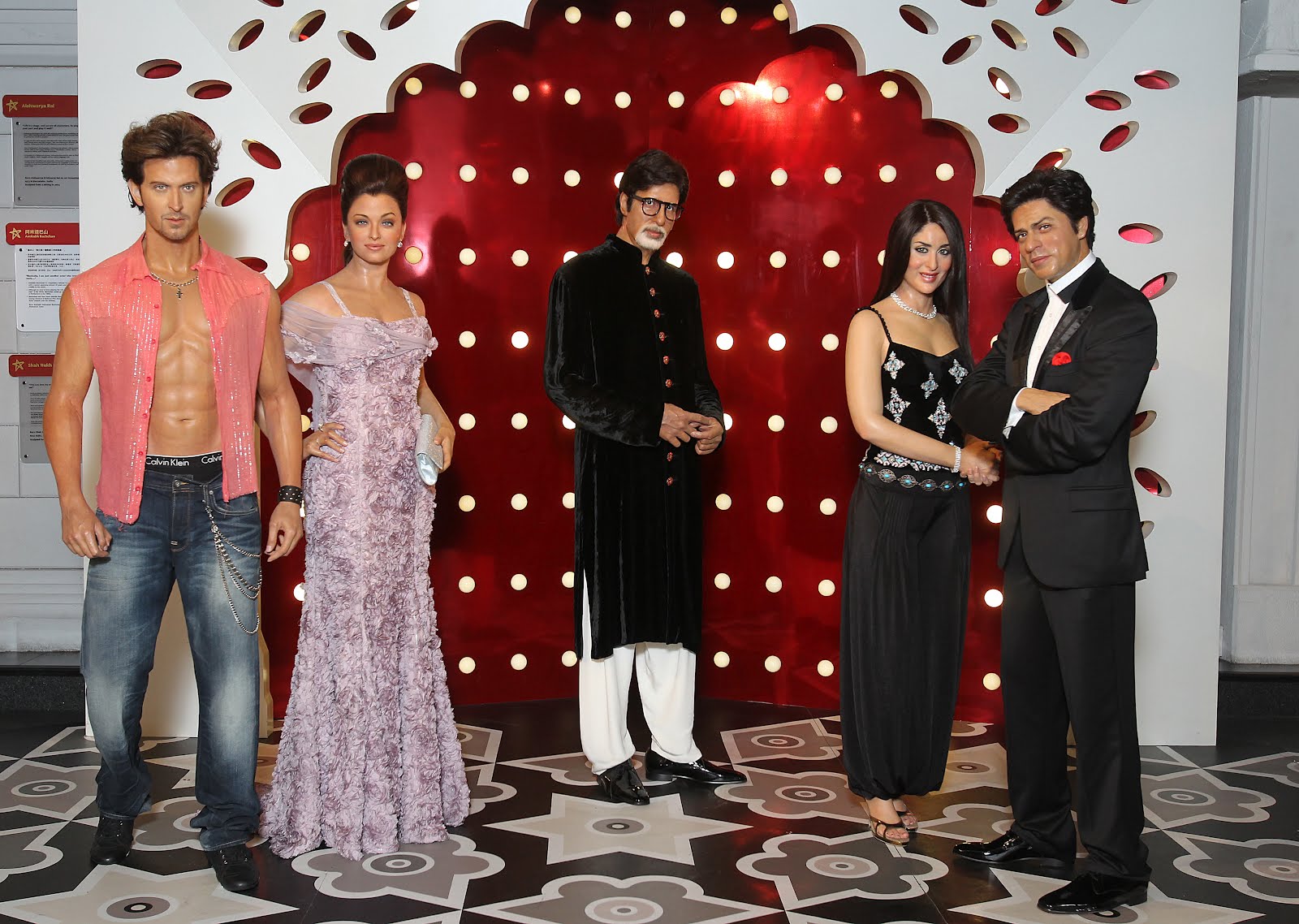
Bollywood al Madame Tussauds di Hong Kong

Dall'8 maggio al 19 luglio 2012, le statue di cera di Amitabh Bachchan, Aishwarya Rai, Shah Rukh Khan, Hrithik Roshan e Kareena Kapoor, provenienti da Blackpool, sono esposte al Madame Tussauds di Hong Kong. In seguito, proseguiranno il loro tour mondiale che toccherà l'Asia, l'America e l'Europa. 

16 maggio 2012

Madonna: I'd like to work with Rahman

A.R. Rahman
Hindustan Times oggi riporta alcune dichiarazioni di Madonna a proposito dell'India.
I'd like to work with Rahman, Collin Rodrigues:
'Although hugely popular in India, Madonna has somehow never performed for her fans here. Talking about what’s kept her away from the country, she says, “I haven’t got the chance to tour India, but I would surely love to.” Ask the international pop icon if she has considered collaborating with India’s very own global musician, A.R. Rahman, and she says, “I would like to work with him when the opportunity comes, and things work out. Only then we will be able to decide on the music.” On her last trip to the country in 2007, the musician had visited Jodhpur and Udaipur with her then-husband Guy Ritchie and her children. Reports had claimed that she even extended her trip by a few days because she loved the desert state so much. “I really did. I had gone with my family and friends and I completely fell in love with the culture and traditions of Rajasthan. I also heard a few folk songs and saw some traditional dances,” she reveals. (...) She hasn’t watched any Bollywood films. “But I know they are very colourful and have huge dance sequences. I’m sure I’ll enjoy them,” she says, before talking about desi music, “I haven’t heard a lot, but I’m familiar with Indian music”.'

Mohammed Hanif: The joys and struggles of everyday life

Vi segnalo l'intervista concessa dallo scrittore pachistano Mohammed Hanif a Qantara, pubblicata il 14 maggio 2012. L'autore presenta il suo nuovo romanzo, Our Lady of Alice Bhatti

'Many in the West equate Pakistan with terrorism. But your new novel isn't about terrorism or the Taliban; it's about the daily fight for survival.
Mohammed Hanif: It is a much more intimate novel. And as you pointed out, it is an insider's look at how life is lived on a day-to-day basis. This is not the kind of life that makes screaming headlines; this is not the kind of life that CNN and FOX and Al Jazeera like to cover. It might seem mundane and boring from the outside, but it is full of little adventures, full of little romances, full of little humiliations, full of tiny terrors. For me, this life is as captivating, as amazing as anything that happens on a global scale.

The main setting is a Christian hospital in Karachi, which seems to be a place where hope is abandoned at the entrance. To what extent should readers view this hospital as a cipher, a symbol for the state of the country as a whole?
Hanif: Most of us who live in urban societies were born in a hospital; at some point we end up there to manage our pains, and even if we are all completely healthy, there is a chance that we will end up there. That kind of fascinated me because it is a very familiar place for most people who live in a city. And obviously it is a world of its own. So if you want to read it as a stand-in for a whole society or a whole country, if you want to read it as a study of a sickness that invades our society, if you want to read it as a study of people who try and cure this sickness - sometimes they fail and sometimes they succeed - most of all, you know, I would like to read it as it is written: a place full of life and death and hope and despair.

To a certain extent, it is a special hospital because it is a Christian hospital. What's more, the main female protagonist is a Christian. This is unusual because the situation of minorities in Pakistan is rarely addressed in the West.
Hanif: I do not usually like the word "minority" because when you call a group a minority, society is absolving itself of its moral and political responsibility. What it says is that here is something that is quite minor and small and doesn't matter because there are things that are bigger and more important and that matter more. But that is not true. Take, for example, women in Pakistan. In terms of numbers, they are the majority; they far outnumber men. But are they treated like a majority? No. We still treat them like a subspecies, like we treat animals that we don't like. And it is similar with other religions; we have a very bad history with them. And it has got to the point where it is not just people who belong to other religions who are affected; people who call themselves Muslims for example are affected too. There is whole sect in Pakistan called the Ahmedis. There is a law that prohibits them from saying they are Muslims. If they call themselves Muslims, they can be sent to prison. And people have gone to jail for that. Then you have Shias being targeted in Pakistan. But if you keep dividing people into these subgroups, you will reach the conclusion that everyone is a minority of one. But to tell you the truth, my main character could have been a Muslim and from the same class background, and she would have had the same experiences. So sometimes yes, it makes a difference if you belong to a different faith. But I have seen cases in real life where you actually do belong to the majority faith, but it is your class that determines your faith, rather then your religion.

What is your name? Where do you come from? What is your religion? Identity still seems to be a driving force and a dividing line inside the country.
Hanif: Yes, completely. Because people still haven't been able to decide the biggest debate in Pakistan, which is this: why did Pakistan come into existence? More then 65 years have passed, and we still haven't been able to reach some minimum kind of consensus on that. There are people who think that this is some kind of divine gift, which is supposed to be an ultra-religious Islamic country. There are other people who argue that this is a country that was created for Muslims so that their economic rights could be protected, and that their country was supposed to be as open to non-Muslims as to anybody else. That is a central debate that goes on in Pakistan and it gets much more complicated with ethnicities: where do you come from, are you a Punjabi or a Sindhi or a Beloch? And then the biggest debate of them all: what class and which clan do you belong to?

It seems to me that by looking at one seemingly small aspect, you give a broad insight into the difficulties and the different layers of Pakistani society.
Hanif: Somebody is dying of hunger or blown up by some explosion or has suffered terribly in some way. That is when it makes it to your TV screen. That is when it gets written about in the newspapers. And that somehow reduces all of society to this bizarre image of either people who are completely suffering or being bombed to death, people who are starving because of national disasters or drones striking people in the mountains, whereas the majority of people live somewhere between these two extremes. There are joys in daily life, there are daily struggles that people have to get through, and sometimes all those struggles are successful. And in among all of this, of course, there is love. That is my major concern in this book: how people fall in love, how they try to live together, and how sometimes it works and sometimes it doesn't.

Well, for Alice it doesn't work in the end. In general the situation for women seems to be very bad...
Hanif: The plain truth is that it is. And I will give you an example of that. I live in Karachi and, like any citizen, I pick up the local newspaper every day, which gives you the news about the city. A few years ago, I realised that every day there would be at least one story about a woman who has been killed in some bizarre way - usually by her own brother, by her own husband, by her own father, sometimes by her own mother or other women in the family. And I am not talking about some remote tribal area or rural area; I am talking about a big city. That is when I started to think about these things. Obviously women's lot is difficult; there is a lot of violence against women. But we must also point out that in my book and also outside in society, there are a lot of women who are very gutsy, who fight back, who have to wage a battle every day to win an inch of space. And that space, I must say, over the years has been increased. It has been a tough battle. But that is a fight that goes on, on daily basis.

The story is set in Karachi, which has long been dogged by riots and ethnic rivalries. To what extent does the city represent the country's problems?
Hanif: Karachi is basically a city of immigrants. When partition took place, it was a city of only 100,000 people, 400,000 people actually. Now it is a city of almost 20 million people and it has migrants not only from all over Pakistan, but from India, Burma, Sri Lanka, Bangladesh, and Afghanistan. So in a way it has become a regional hub for migrants. And despite all the violence and despite all its problems, it is still the kind of city that gives people a livelihood. So in a way it does represent a lot of the country's problems: all the religious differences, all the ethnic differences, the black economy that exists in Pakistan and in the region. But at the same time it also represents what is perhaps the only hopeful model for the country. There are people who are so diverse, people who speak completely different languages and belong to completely different ethnic backgrounds and sometimes belong to completely different religions. If they can live on the same street, than the rest of the country can also follow the same model'.

Project to give Mumbai a Bollywood mural makeover

Le celebrazioni per il centenario del cinema indiano stanno coinvolgendo anche i comuni cittadini. Due designer mumbaiti hanno inaugurato il Bollywood Art Project, un'iniziativa che, grazie alla collaborazione dei leggendari pittori di manifesti  (oggi in disgrazia), si ripromette di decorare la metropoli con una serie di giganteschi murales a tema cinematografico. Il primo - alto 6 metri - si trova a Bandra, ed è immortalato nella fotografia a sinistra: si tratta del film Anarkali (1953). Durante il fine settimana la pellicola è stata proiettata all'aperto sulla stessa parete come sfondo. Il secondo è in fase di realizzazione: un ritratto di 18 metri di Helen. 
Project to give Mumbai a Bollywood mural makeover, Shilpa Jamkhandikar, Reuters, 16 maggio 2012: '“Mumbai is the home of Bollywood, but it has no Bollywood flavour,” said Ranjit Dahiya, who started the project with his friend, Tony Peter. “We wanted to change that.” (...) “We have a lot of indications around Mumbai of what Bollywood is today, in terms of posters of latest releases, but there is no indication of where we came from,” Peter said. (...) Peter says he hopes to recruit more of India’s poster painting stars into the project, indirectly helping workers skilled in the once-flourishing art of hand-painted, larger-than-life posters, who have been struggling in recent years. Both Dahiya and Peter have regular day jobs in design but say their project has become an all-consuming hobby'.